About the Journal
Pakistan Journal of American Studies (PJAS) is an interdisciplinary, peer-reviewed journal produced by Area Study Centre for Africa, North and South America, Quaid-I-Azam University, as part of its research and publication program. The Journal provides a dynamic, dedicated and scholarly platform for researchers, academics, policymakers and analysts of Pakistan to explore the multifaceted dimensions of American history, culture, politics, literature, foreign policy, economics, and its international relations, with particular emphasis on South Asian and global perspectives. PJAS holds a unique position as the only journal of American Studies in Pakistan. The sole objective of journal is to bring all current research on the aforementioned topics into the great debate surrounding the global peace process and prosperity.
The journal is published bi-annually in January and August every year.
Opinions expressed in the Journal are those of the authors and do not necessarily reflect the views of the Centre.
PJAS acknowledges the financial support of the Higher Education Commission, Islamabad.
Copyright 2018 by the Area Study Centre for Africa, North & South America. Publication permitted under Memo No. 447/PC134, 11 April 1983. Printed by Pakistan Scientific and Technological Information Centre Press, Islamabad. ISSN 1011-811Χ.
Subscription Rates:
Pakistan: Annual: Rs.500
Overseas: Annual: US$50
Current Issue
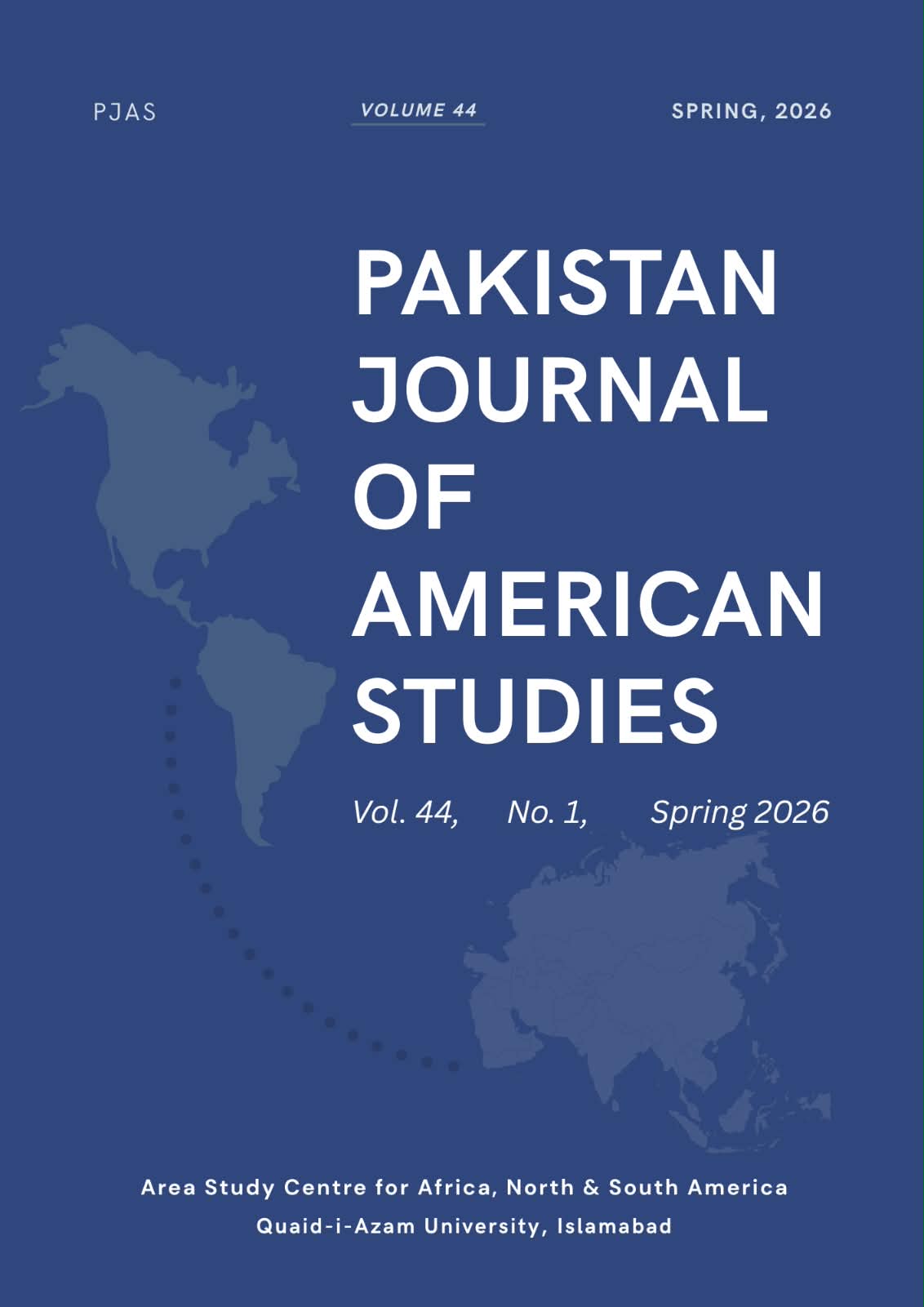
Editor's Note
Founded as the first and only journal of its kind in Pakistan, the Pakistan Journal of American Studies (PJAS) focuses on research at the intersection of the humanities and social sciences in American Studies, spanning the history, literature, politics, foreign and security policy, culture, and soft power of the Americas, North and South. The journal aims to illuminate the significance of the Americas in their engagement with other regions, particularly South Asia and Pakistan, and to provide a platform for policy-relevant scholarship.
This issue brings together five papers united by a common concern with power: how it is claimed, contested, and legitimized across very different terrains. Two contributions turn to literature to trace this dynamic, while the rest turn to the global stage, taking up climate governance, US-Pakistan strategic relations, and the domestic political crises confronting the Trump administration.
Ada Nabi Mir, Zohaib Gillani, and Arhamna Azam open the issue with a study of Gabriel García Márquez's One Hundred Years of Solitude, asking how gendered ideologies of machismo and marianismo function as strategic choices within a system of patriarchal power. Combining game theory with New Historicist and gender-theory frameworks, and running computational models in R, they find that machismo tends to win in the short run but loses out over time, while marianismo survives longer, at considerable personal cost to the women who practice it.
Yussef El Guindi's play Back of the Throat is the subject of Muhammad Ayub Khan and Hafiz Abid Masood's contribution. They ask how post-9/11 American state structures construct and criminalize Arab and Muslim identity, drawing on Khaled Beydoun's model of American Islamophobia, Michel Foucault's account of panopticism, and Edward Said's work on identity. The play, they argue, dramatizes Arab Americans as subjects of surveillance and suspicion, cast as the new villains of a securitized state.
Shakeel Ahmed takes up global climate governance and asks whether responsibility for the climate crisis should fall on states collectively or be assigned individually to major emitters such as China and the United States. Neither position holds up on its own, he argues: a purely shared approach ignores real differences in emissions, wealth, and capacity, while a purely individual one undermines the cooperation climate governance requires. He proposes a combined framework instead, one that mixes shared, differentiated, and individually enforceable responsibility.
The shift in US-Pakistan relations from security aid to a critical-minerals trade partnership is the focus of Shabnam Yousaf and Sajid Mahmood Awan's paper. Does this shift reflect deliberate bilateral design, they ask, or a deeper structural compulsion? Applying Kenneth Waltz's structural realism and Edward Luttwak's geo-economics across a ten-stage sequential cascade spanning Pakistan's mineral endowment, the FWO-USSM Agreement, and China's dominance of mineral supply chains, they conclude the shift is systemically driven, with consequences reaching into the broader architecture of great-power competition over critical resources.
Finally, Daman Bozdar and Mustafa Bozdar examine the crises confronting the Trump administration through May 2026, when the Epstein files scandal and the war against Iran converged to threaten the presidency. They ask whether the "Wag the Dog" narrative surrounding Operation Epic Fury amounts to a deliberate diversion from the Epstein controversy, weighing this against comparisons to Watergate and the Lewinsky scandal, along with the constraints of the War Powers Resolution and pending impeachment threats. Trump retains a solid Republican base, they conclude, even as legal scrutiny, economic fallout, and intra-party dissent create a volatile political environment.
Altogether, this issue, read through literature, law, strategy, and politics, shows how differently American power can be understood and how that understanding connects back to Pakistan's own place in the world. Since the next issue of PJAS will focus on US foreign policy, we welcome submissions from scholars working in this area. We hope it sparks discussion and draws more scholars to this field.
Dr Munawar Hussain
Editor, Pakistan Journal of American Studies (PJAS)
Full Issue
Articles
Editor in Chief
Dr. Raja Qaisar
Editor
Dr. Munawar Hussain
Assistant Editors
Abdul Hussain (PhD ASC)
Hafsa Jadoon (PhD ASC)
Basit Pervez (Mphil ASC)
Advisory Board
Ijaz Hussain M. Rafique Afzal
Sikandar Hayat Anwar H. Syed
Tanvir Anjum Hasan-Askari Rizvi
Randall Stokes Muhammad Waseem
Maqsud-ul-Hassan Nuri
Rasheed Ahmad Khan
Editorial Office
Pakistan Journal of American Studies, Area Study Centre for Africa, North & South America, Quaid-i-Azam University, Islamabad 45320, Pakistan.
Tel: 092-51-2896006/8
Fax: 092-51-2896007
Email: pjasqau@gmail.com